


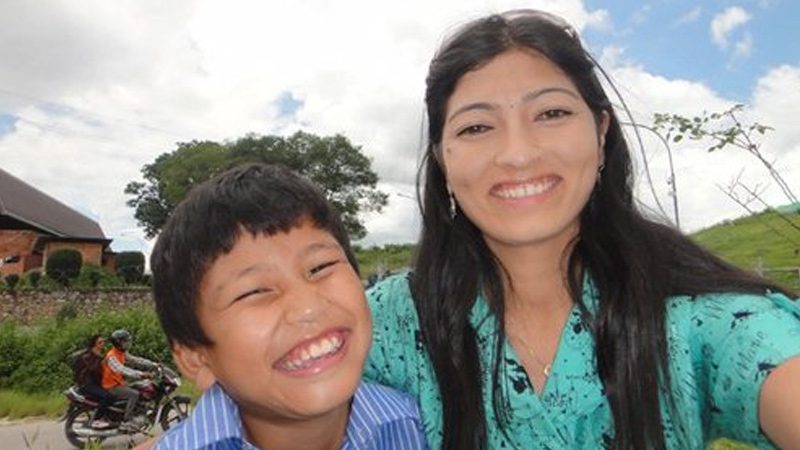
When you first meet Sabita Upreti, you will notice a rough mark on her right cheek or ‘a gift’ as she likes to call it, from an autistic 3-year-old boy who had left a bite mark.
She has centred her world around autistic children in Nepal for over a decade. Her dream is to help empower and make autistic people accepted by their families.
Upreti is not autistic, and had never encountered an autistic person until she visited the Nepalese capital Kathmandu at the age of 16.
But she felt like there was something in common between herself and the children she referred to as the most neglected. The children were unable to express their feelings, yet Sabita was unable to feel their ‘deep sense of pain’.
Sabita was born in Dolakha in 1982, but her birth was not celebrated as the family feared the birth of a baby girl. Her mother Bhawani came from a decent family, but the father’s side of the Upreti family were the poorest.
Over the years the family experienced increased hardship, and Sabita would be locked in a room alongside her four siblings, as their mother would go to work for long hours.
However, Sabita was close to her mother and over time had developed more confidence from her mother which she struggled to see in herself. She recalled how her mother was the one who let her study in Kathmandu.
Sabita arrived in the capital in 2000, and quickly referred to it as the ‘rude city’ which taught her the toughest lessons in her life.
“When you are an outsider and poor, your dignity is always at stake, your dreams can shatter and sometimes you cannot recollect them,” Sabita recalls those bitter days.
She would struggle to pay rent and manage expenses to keep pace with life. But in 2008, Upreti and her life changed for the positive.
Sabita was hired as a Management Officer for the Nepalese National Disabled Fund. She would often go about on field visits, meeting disabled people from all walks of life. But one particular boy Bhaktapur changed the course of her life.
“I saw him in a slum area. He was naked, stinking, eating his own feces. His parents were not able to look after him due to poverty. That scene kept haunting me”, Sabita said.
Most parents in Nepal would be unaware if their children were in fact autistic. They would smash things, look untidy and vulnerable and they still would not know.
Sabita visited India for training on how to handle autistic people, and in 2009 founded the Special Education and Rehabilitation Center for Disabled Children (SERC).
SERC offers therapies and activities for autistic children which the parents appreciate and make contributions to the organisation.
In the last decade, Upreti has visited a number of countries to exchange knowledge about autism and bring home better experiences and voices for autism.
She has been awarded the Janasewa Shree Padak by the 2nd President of Nepal, Bidya Devi Bhandari for her dedication.
Due to Upreti’s efforts, the Nepalese government recognised autism as a disability; and more policies are in the pipeline. In the next census later this year, Nepal will collect data on autism for the first time.
The World Health Organisation estimates that there are around 300,000 autistic people living in Nepal.


