


The United Kingdom’s Secretary of State for Justice will attempt to overturn a ruling in April 2021 that allowed social workers to help their clients pay for sex
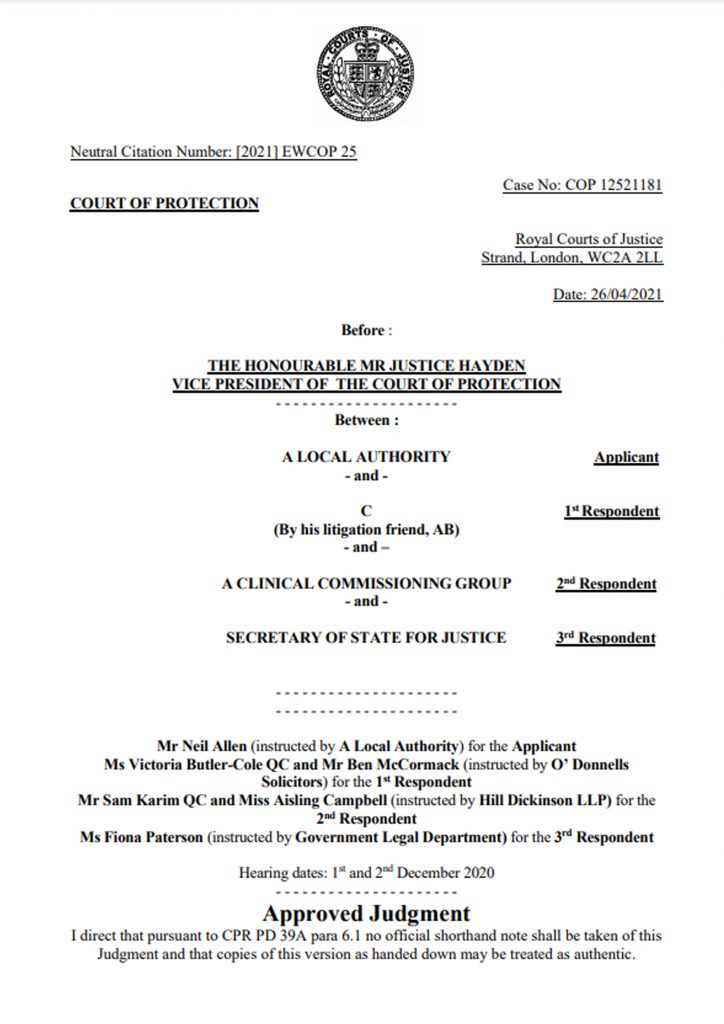
A landmark decision by a United Kingdom court, ruled that support workers for an autistic man, referred only as “C”, should not be prosecuted if they help him pay for sex.
Mr Justice Anthony Hayden, vice president of the Court of Protection, made the ruling that carers of ‘certain patients’ should be helping them with this particular “important sphere of human interaction”.
C was diagnosed on the autistic spectrum at a young age, and in 2018 he reportedly told his social worker and a litigation friend that he wanted a girlfriend – but considered his prospects pretty limited.
He said he wanted to be able to have sex and wished to know whether he could have contact with a sex worker. C’s social worker and Local Authority than investigated the lawfulness of such contact.

In the United Kingdom, it is legal to pay for sexual services but a number of activities, including solicitation in a public place, kerb crawling, managing a brothel and pimping are considered crimes under the Sexual Offences Act 2003.
Mr Joshua Rozenberg QC said it would be a breach of Section 39 for a care worker to cause or incite another person to engage in sexual activity but Mr Justice Hayden rejected that interpretation.
The court heard that C, who is now 27-years-old, displayed some “significant behavioural problems including aggression and dangerous behaviour” during his youth.
In 2014, C was detained under the Mental Heath Act when his behaviour deteriorated and made threats of a sexual nature although none of them acted upon.
C was discharged from hospital in 2017 where he has since been placed in supported accommodation with live-in carers. Mr Justice Hayden accepted that he was happy and well-supported.
Section 39 of the Sexual Offences Act of 2003 was designed to to criminalise exploitation of the vulnerable.
Joshua Rozenberg QC wrote on his blog, “It is intended to signal unambiguous disapprobation of people employed in caring roles, who cause or incite sexual activity by a person for whom they are professionally responsible. The legislative objective is to criminalise a serious breach of trust.”
But Robert Buckland, who was representing the Secretary of State for Justice took a different view and they will be attempting to overturn Justice Hayden’s judgement today (July 29th).
The appeal case is likely to be regarded as a test case, which will be heard by the Lord Chief Justice Lord Burnett of Maldon, Lady Justice King and Lord Justice Baker.
We currently have a law that says helping someone solicit for sex is illegal under Section 39 of the Sex Offenders Act and Justice Hayden’s judgement by the Court of Protection which is in direct conflict.
It is likely that a decision will be reserved for some weeks before a judgement is made.


