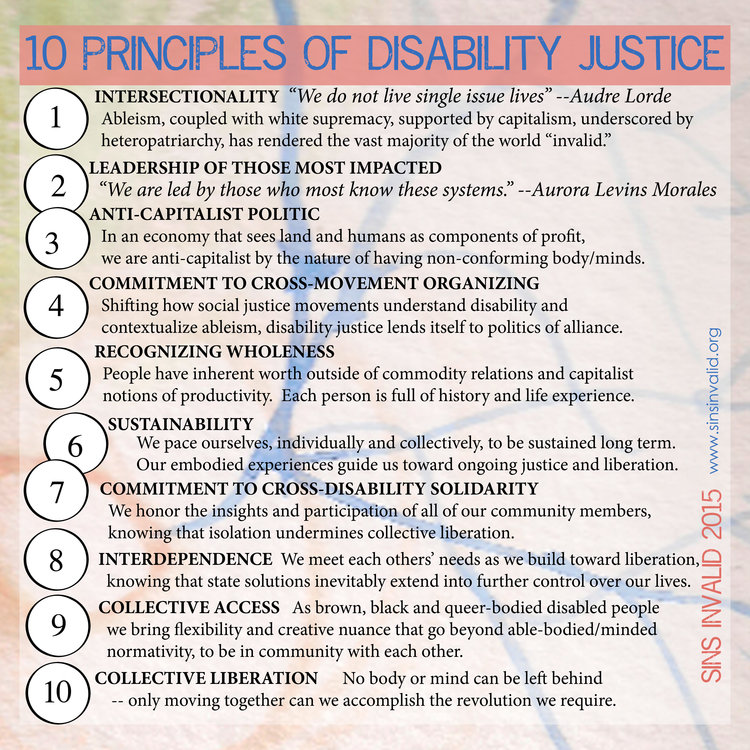



Back in 2015, disability justice based project Sins Justice celebrated artists of disabilities, people of colour and those of the LGBTQ+ communities to challenge the paradigms around ‘What is normal’?
Sins Justice came up with these ten principles how you can campaign and align your values with those of the disability justice movement.
They provide themselves of being disruptive agitators to evoke positive change in their communities.
Below is a list of these commandments:

1. Intersectionality
“We do not live single issue lives” –Audre Lorde. Ableism, coupled with
white supremacy, supported by capitalism, underscored by heteropatriarchy, has rendered the vast majority of the world “invalid.”
2. Leadership of the most impacted
“We are led by those who most know these systems.” –Aurora Levins Morales
3. Anti-capitalist politic
In an economy that sees land and humans as components of profit,
we are anti-capitalist by the nature of having non-conforming body/minds.
4. Cross-movement organisation
Shifting how social justice movements understand disability and contextualize ableism, disability justice lends itself to politics of alliance.
5. Wholeness
People have inherent worth outside of commodity relations and capitalist notions of productivity. Each person is full of history and life experience.
6. Sustainability
We pace ourselves, individually and collectively, to be sustained long term. Our embodied experiences guide us toward ongoing justice and liberation.
7. Cross-Disability solidarity
We honour the insights and participation of all of our community members, knowing that isolation undermines collective liberation.
8. Interdependence
We meet each others’ needs as we build toward liberation, knowing that state solutions inevitably extend into further control over lives.
9. Collective Access
As brown, black and queer-bodied disabled people we bring flexibility and creative nuance that go beyond able-bodied/minded normativity, to be in community with each other.
10. Collective Liberation
No body or mind can be left behind – only moving together can we accomplish the revolution we require.