

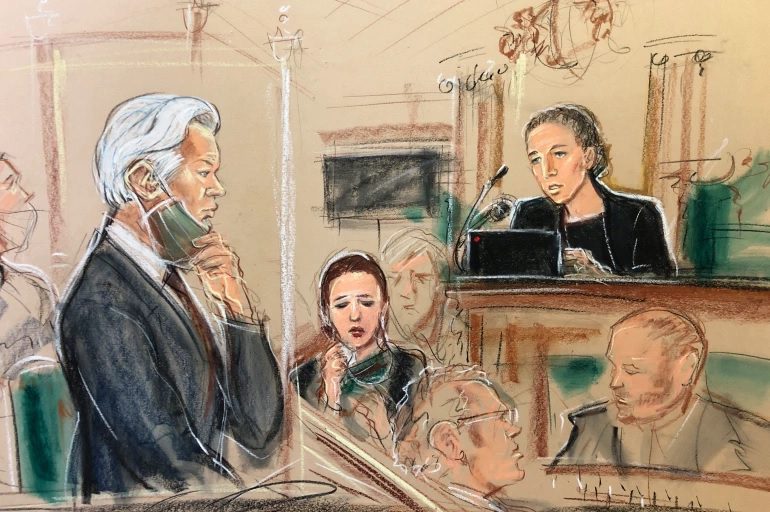


LONDON (Reuters) – Julian Assange, the founder of WikiLeaks has been confirmed to have been diagnosed with autism, at a British court in London today.
It comes after British judge, Vanessa Baraitser ruled that Assange should not be extradited to the United States to face criminal charges of spying.
U.S. authorities have accused the 49-year-old of 18 offences related to his WikiLeaks organisation, with vast troves of U.S. military records and diplomatic cables, which the United States say put lives in danger.
He has spent the last decade in confinement, when he fled to an Ecuadorian embassy in London, from which he spent seven years.
In April 2019, after his asylum was revoked by Ecuador, the Ambassador of Ecuador invited the Metropolitan Police into the embassy on 11 April 2019 to arrest him.
Judge Vanessa Baraitser was told that the real risk to Julian Assange was that he would commit suicide if he was held in a maximum security U.S. jail.
The court was told that Mr. Assange made regular calls to the Samaritans charity from Belmarsh prison.
He also spent six hours of phone calls with Dr Quinton Deeley, a consultant neuropsychiatrist, who diagnosed Assange with Asperger’s syndrome after witnessing a two-hour autism assessment.
The psychiatrist told the extradition hearing earlier in September of last year, that it is clear the WikiLeaks founder is on the autism spectrum.
When Dr Deeley gave evidence to the hearing, he said he spoke to Assange’s parents during his assessment, “To my mind, it’s clear Mr Assange presents as a person with an autistic spectrum condition.
“He’s an intelligent person, he’s learnt to adapt to some of those characteristics.”
Judge Vanessa Baraitser when making her judgement, said Assange suffered at times from severe depression and had been diagnosed with autism. Half a razor blade was also found in his Belmarsh prison cell in May 2019, and he had told medical staff of suicidal thoughts and making plans to end his life.
“I find that Mr Assange’s risk of committing suicide, if an extradition order were to be made, to be substantial,” Judge Baraitser said in her ruling, at London’s Old Bailey court.
“The overall impression is of a depressed and sometimes despairing man, who is genuinely fearful about his future.”
Wearing a navy suit and mask, Assange showed little emotion when the ruling was made, but his partner Stella Moris, who has two children with him when he sought asylum at the Ecuadorian embassy, said the verdict was a victory but the threat of extradition still hanging over him.
Assange’s lawyers said they will now seek bail for their client on Wednesday 6th, but a U.S. Department of Justice spokesperson said, “We will continue to seek Mr. Assange’s extradition,” adding that the United States have won all the legal points, including arguments that relate to freedom of speech and political motivation.
His legal team have argued his entire prosecution was brought on by pressure from U.S President Donald Trump’s administration, and that the extradition of their client would pose a serious threat to press freedom.
Judge Vanessa Baraitser rejected Assange’s lawyers’ arguments that the case was political and an assault on journalism, saying there was insufficient evidence to claim that Trump’s administration was pressuring prosecutors.
But she did say there was a real risk that, if found guilty, Assange would be held in the ADX Florence maximum security prison (SAM) in almost total isolation, and that he would find a way around their suicide prevention measures.
“I am satisfied that, if he is subjected to the extreme conditions of SAMs, Mr. Assange’s mental health will deteriorate to the point where he will commit suicide,” Judge Baraitser said.